

Software-defined radio testing with Nominal Connect
Real-time, customizable data viz, so engineers can update with confidence
Testing in a software-defined world
Complex hardware systems are no longer static objects. They continuously adapt and evolve. Operational assets across aerospace, energy, robotics, and more can behave entirely differently, operate entirely differently, based on software updates. They are software-defined.
This is one of many reasons that hardware test has radically changed over the past year. Test is no longer a phase in development, it’s persistent process woven directly into operations. Every update generates new behaviors, data profiles, and learnings. As we like to say at Nominal: Every asset is a test stand. The fastest companies use their vast stores of operational data as the foundation for new development. Their testing is connected, from development through operations – and back.
This new reality is relevant from fleets of autonomous vehicles down to individual radio frequency signals – every update demands immediate validation in real-world conditions.
In this post, we explore one practical example of testing a software-defined system in Nominal.
RF spectral analysis in Nominal Connect
Countless industries and technologies depend on radio frequency (RF) signals. For the engineers building and testing these systems, it is critical to be able to collect, analyze, and visualize RF data in real time.
Nominal Connect provides RF engineers with a clean and intuitive software platform for ingesting and displaying RF data live. With a customizable and low-code UI/UX, engineers can command RF sensors, ingest signals, and display real-time data all in a single platform.
Read our post on antenna impedance characterizationSoftware-defined radio (SDR)
Traditionally, key radio components such as mixers, filters, amplifiers, and modulators/demodulators were implemented in specialized analog hardware. With advances in modern computing and analog-to-digital converters, many of these components can now be implemented and updated via software (AKA ‘Software-defined’). Migrating these components into software enables a single radio to receive and transmit a wide range of different waveforms without the need for custom hardware, making SDRs flexible, adaptable, and low-cost.
Using Nominal Connect to analyze RF data from an RTL-SDR
RTL-SDR is an ultra-low-cost commercial SDR capable of receiving frequencies ranging from 500 kHz to 1.75 GHz, depending on the particular model. With an SMA connector at the front-end and a USB interface, the RTL-SDR can be paired with an antenna and commanded from an external operating system. There are open source libraries for commanding the RTL-SDR and streaming live IQ data. Users can make use of Python wrappers to write simple scripts for interfacing with the RTL-SDR.
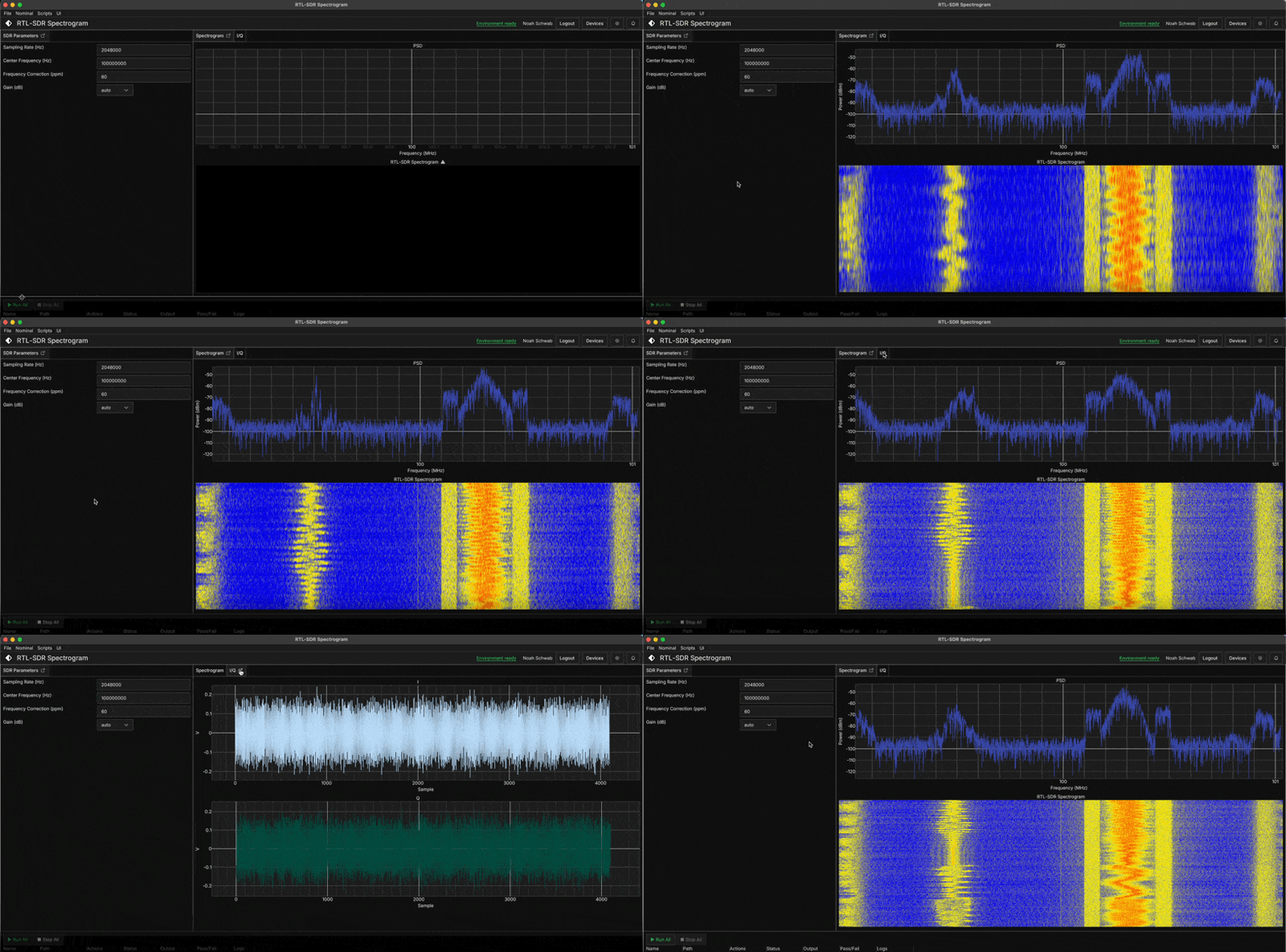
Connect offers several customizable widgets specifically for RF spectral analysis, such as a Power Spectral Density (PSD) plot and a Spectrogram. The video below is a screen capture of a Connect application built specifically for interfacing with an RTL-SDR and visualizing the received RF data in real time. In under 75 lines of code, the underlying Python script accepts user inputs to configure the SDR and returns live IQ data that is ingested by Connect to display the plots shown.
Accelerating hardware in a software-defined world
With simple, customizable interfaces for controlling & observing SDRs, engineers get clear feedback on every update. Rather than sifting through batched or unstructured data, engineers iterate in real-time and deploy their system to the next critical use-case.
Beyond this functionality, Nominal Connect also integrates seamlessly with Nominal Core for deeper analysis & historical comparisons. Data from every software update is stored, indexed, and queryable. With every version & iteration at their fingertips, engineers can quickly identify trends or out-of-family behavior. No matter how often your hardware updates, Nominal lets you adapt quickly – with confidence.